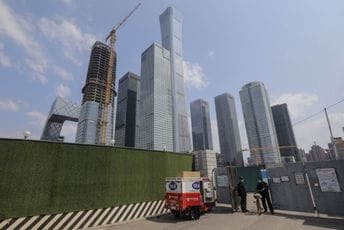
The difficulties faced by the Chinese construction giant could result in consequences of significant magnitude if the government in that country doesn’t find a mechanism for rescue. However, despite many drawing comparisons to the onset of the global financial crisis in 2008, the situation, though extremely complex, is still different.
The author’s article was originally written for Portal Analitika on September 23rd, 2021 | Photo: EPA-EFE
The Chinese company Evergrande was relatively unknown to most Europeans until it gained global attention with the announcement that its potential collapse could trigger a new global financial crisis.
This is a Chinese real estate giant founded in 1996, less known in Western markets, and it’s also the largest property developer in the country. Its founder, Xu Jiayin, was the richest man in China in 2017.
Uncertainty and Concern
The Chinese giant is facing bankruptcy, and yesterday it announced the payment of interest on a small portion of its debt, but without reassuring the financial markets, which are still waiting to see if the official Beijing government will intervene and to what extent.
The events in Evergrande have sparked concerns worldwide that a scenario similar to the one caused by the collapse of the investment bank Lehman Brothers in September 2008 could be repeated.
The feeling of concern has significantly impacted the capital markets, with all eyes on the Chinese government, which hasn’t clearly indicated whether it will intervene in favor of the troubled construction conglomerate facing a debt of 260 billion euros.
While outstanding obligations still threaten the group’s survival, Evergrande has managed to reach an agreement with bondholders for a small portion of its debt.
In a letter sent to the Shenzhen Stock Exchange, the group mentioned that one of its subsidiaries, Hengda Real Estate Group, had been negotiating a plan to pay interest on a bond due in 2025. According to Bloomberg’s data, Evergrande was supposed to pay 232 million yuan (30.5 million euros) of debt that matured last Thursday, related to a bond with a 5.8% interest rate, limited to the domestic market.
The announcement of interest payments wasn’t sufficient to calm the markets. The Shenzhen and Shanghai stock exchanges continued to decline, even after a four-day pause due to national holidays. The Hong Kong Stock Exchange remained closed.
Creditors’ Claims
The repayment deadline for loan installments is today, and the group hasn’t specified how it intends to settle them. The partial repayment announcement is meant to reduce instability and prevent a collapse.
For trust to truly return, market participants need to see a genuine restructuring of Evergrande. The response from the Chinese government is most anticipated by the owners of 1.4 million apartments under construction, who organized protests outside the company’s headquarters and in various locations across the country last week.
Creditors, employees, and suppliers are also demanding Evergrande fulfill its debts, which increased investments until last year when Beijing tightened borrowing rules. The group’s chairman, who currently denies the possibility of bankruptcy, assured employees that Evergrande would “soon emerge from the darkest days,” as reported by Chinese state media two days ago.
Multi-billionaire Xu Jiayin reassured that construction would continue as planned and the group would offer a “response to customers, investors, partners, and financial institutions.” However, he didn’t provide further details.
The notion of Evergrande’s collapse raises concerns due to its colossal debt exceeding 300 billion euros and its economic involvement spanning over three million direct and indirect jobs, projects in more than 200 cities, and partnerships with over 8,000 companies.
Evergrande’s downfall could have significant implications for China’s job market, as it employs 200,000 people and indirectly engages over 3.5 million associates. Furthermore, it’s facing illiquidity, leading many affiliated companies to halt their activities, consequently stopping construction projects nationwide.
Differences Compared to the Year 2008
Although uncertainty has gripped the markets lately, with questions arising about whether China is heading toward a collapse of the giant Evergrande, the situation is not comparable to the one the world witnessed in 2008. The current scenario is not likely to trigger a global crisis, though efforts to overcome the problem will involve numerous entities.
Despite liquidity issues, the effects of a potential bankruptcy wouldn’t be as severe as the collapse of hedge funds with massive positions or a bank with assets approaching zero value.
Land, Not Financial Assets
Comparisons to Lehman Brothers are inappropriate, as Evergrande owns tangible real estate assets, including land, whose value can fluctuate but won’t disappear entirely. Lehman Brothers, in contrast, had financial assets whose value was completely wiped out. A single stimulus could enable Evergrande to complete some properties, sell them, and gradually repay its debt.
The present value of the land and housing projects is estimated at slightly over 1.4 trillion yuan (185 billion dollars). This is a crucial difference from Lehman Brothers, where the complete erasure of value from financial derivatives—credit default swaps and collateralized debt obligations—affected other banks.
Land prices are more transparent and stable than financial instruments, particularly in China, where local governments have a monopoly on the majority of land and can even repurchase it if needed. The value of land isn’t expected to depreciate due to such events.
Moreover, unlike Lehman Brothers, which operated in a somewhat independent system, Evergrande is subject to high levels of government control and involvement in the Chinese real estate sector. Additionally, intermediaries don’t play a pivotal role as they did in the case of the U.S. bank. All strings are in the hands of the Chinese government.
Awaiting Concrete Government Action
Chinese banks and numerous other entities are under the supervision of national institutions with decision-making authority. Even non-state financial services can be controlled to an extent that’s unimaginable outside China.
In other words, if a commercial entity in China truly fails, it means the government has assessed that there’s no broader interest justifying its rescue. Chinese authorities have two key objectives: preventing excessive risk-taking and maintaining stability in the real estate market.
Thirteen years ago, Lehman Brothers went bankrupt, and the U.S. government began rescuing other financial entities. This was also seen in Europe, where banks were saved instead of economies. The collapse of one bank, caused by overvalued assets that were suddenly devalued, was addressed by saving other banks.
 Perperzona